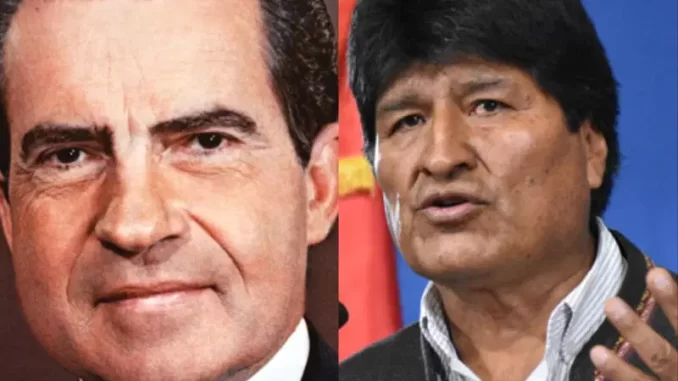
In history, there have been some presidents who resigned from office in what is a rare and dramatic moments.
Cases like this often occur during times of scandal, crisis, or social transformation, offering a fascinating glimpse into the pressures and pitfalls of leadership.
Whether it’s Richard Nixon’s infamous Watergate downfall, Ferdinand Marcos fleeing the Philippines, or Boris Yeltsin handing over the reins of post-Soviet Russia to a younger successor, each resignation tells a unique story of crisis and consequence.
Here, are 9 presidents from around the world who resigned from office.
Richard Nixon (United States, 1974)
Richard Nixon was the first and only U.S. president to resign as a result of the Watergate scandal on August 8, 1974, which revealed unlawful actions, and a subsequent cover-up related to his government.
Ferdinand Marcos (Philippines, 1986)
Following a strong protest in the Philippines by the Pure Power Revolution group which was triggered by claims of massive corruption and electoral fraud throughout his extended rule, Ferdinand Marcos resigned and fled the country and took refuge in Hawaii with his family.
Raul Alfonsín (Argentina, 1989)
Raúl Alfonsín resigned six months before his mandate was about to expire in the midst of huge protests and an economic catastrophe. Alfonsín’s early resignation has been viewed as a pragmatic political decision in an attempt to reduce tensions and facilitate the transition to the next administration.
Suharto (Indonesia, 1998)
After 31 years as president, Suharto resigned on May 21, 1998, over the Asian financial crisis and mass protests against corruption, human rights abuses, economic mismanagement, and political resistance to his autocratic regime.
Boris Yeltsin (Russia, 1999)
Boris Yeltsin was the first president of post-Soviet Russia to shock his country by resigning on December 31, 1999. Citing health issues and the necessity for younger leadership, Yeltsin ceded power to his hand-picked successor, Vladimir Putin, just before the year 2000.
Alberto Fujimori (Peru, 2000)
Fujimori resigned electronically by sending a fax from Japan after being accused of corruption and human rights abuses, but Congress rejected his resignation and impeached him.
Hosni Mubarak (Egypt, 2011)
After massive demonstrations against repression, corruption, and economic inequality, Mubarak’s 30-year rule in Egypt ended on February 11, 2011. His resignation was a turning point in Middle Eastern politics, proving the effectiveness of group action in opposing authoritarian governments.
Otto Pérez Molina (Guatemala, 2015)
Due to a corruption scandal known as “La Línea,” which involved customs fraud, Otto Pérez Molina resigned from his position in Guatemala after Congress voted to revoke his immunity, putting him at risk of arrest and legal action.
Evo Morales (Bolivia, 2019)
Bolivia’s first Indigenous president, Evo Morales, resigned after being pressured by the military over weeks of demonstrations and accusations of electoral fraud during his controversial reelection campaign.
Leave a Reply