In an interview, Akeredolu, visibly shaken as he recounted the tragedy, disclosed that his son, Abdulmalik, who died in the incident, had scored 320 marks in the Unified Tertiary Matriculation Examination (UTME).
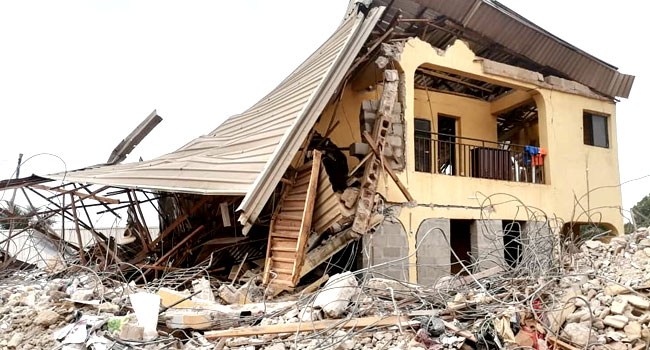
In the wake of the devastating building collapse at Ota-Ona, Ikorodu, which claimed the lives of three family members, including two children, 49-year-old Saheed Akeredolu, a school bus driver and relative of the building owner, has spoken out about the heartbreaking incident.
In an interview, Akeredolu, visibly shaken as he recounted the tragedy, disclosed that his son, Abdulmalik, who died in the incident, had scored 320 marks in the Unified Tertiary Matriculation Examination (UTME).
“My son, Abdulmalik, was my firstborn. I worked closely with him. There are many reasons why I’m proud of them. For example, he did very well in his UTME. He scored 320,” Akeredolu said in the interview with PUNCH.
“It was a big achievement. He was an electrician by training and planned to study Electrical Electronics at university, but it’s sad he is dead.
Abdulmalik had been offered admission by his first-choice university, the University of Lagos, as well as Lagos State University.
According to his father, both institutions had sent congratulatory messages to the family.
The incident, which occurred while Abdulmalik, 18, and his younger sister Amira, 13, were inside the newly constructed building, has left the family shattered.
Their 78-year-old great uncle also died in the collapse.
Describing the moments before the building came down, Akeredolu said, “It was a normal day; all my three children and their mum were home. It was my son and my youngest daughter who were inside the new building.
“There is a small space inside the compound, and that is where we stayed to get the main building completed.
“So, I called my son to help me with some things, and he promised to come soon. I eventually fell asleep inside that small building.
“Later, he came and saw that I was already asleep, quietly took his phone, and called his younger sister so they could spend some time together in the unfinished building. Their mum, sister, and I were in the small building.
“When the building collapsed it was the sound that woke the three of us up; we were in the old building. When we realised what had happened, we started looking for them. That was it.”
He revealed that the children had gone to the uncompleted structure to pray.
“They had gone there to pray. Yes, they were praying at about 1 p.m. on that fateful day. It was while they were praying that the building collapsed,” he explained.
“They went to pray in the uncompleted building because of how things are in the community.
“They usually preferred to go and pray at the mosque, but there is a curfew in our area. My son didn’t want to leave his younger sister behind. So, they all stayed there to pray together.
“You talked about curfew; did you mean there was a traditional curfew in your area?
“Yes. In our area, we call it Igemo; it is a traditional curfew where women are not allowed to go out. Women are expected to stay indoors.”
Akeredolu, who has now lost two of his three children, lamented that only one daughter remains.
“I had three. But now, I’m left with just one; she is 16 years old now.”
He confirmed that about seven construction workers survived the collapse.
“From what I’ve learnt, all the workers there survived the accident, about seven of them, because they were mostly on the top floor,” he said. His children and uncle, however, were on the first floor and could not escape.
Regarding the building’s structural integrity, Akeredolu maintained that high-quality materials were used.
“From the beginning, we used solid, high-quality materials. To be clear, every material we used was certified as standard,” he insisted.
He also stated that the building had received all necessary approvals.
“Yes, both the state and local governments inspected the building at various stages. We have official certificates to prove that. The government gave approvals at every stage before construction moved forward.”
Despite the devastating loss, Akeredolu expressed uncertainty about the cause of the collapse.
“I’ll keep saying this: only God knows what happened. Honestly. Even people who used to pass by or live around us often said, ‘Is it the government that owns this house?’ The structure looked very solid.”
Construction had been nearing completion at the time of the tragedy.
“Just before it happened, they were doing the final touches. Two days ago, they finished the external plastering. After that, they started working inside, internal plastering,” he recounted.
His uncle, the 78-year-old man who died alongside the children, had been supervising the project.
“He was my mother’s younger brother. He lived in Egbeda but came here to supervise the building project. He came to support us and helped with the construction,” Akeredolu said.
As he faced the immense grief and destruction left behind, Akeredolu appealed to the government for support.
“Well, since the government approved the building, I am really hoping for their support now. Nothing is left with me, nothing at all, except for my wife and my other daughter. That’s all I have now.”
He disclosed that the building was financed by a family member abroad.
“My mother owned the land. The building was on her land, and her grave is on the land as well.
“They were six in their family, and it’s the last born who is abroad that has been sending the money we are using to build the house.”
As investigations continue into the cause of the collapse, Akeredolu and his family are left grappling with the painful aftermath of a tragedy that has forever altered their lives.
Leave a Reply