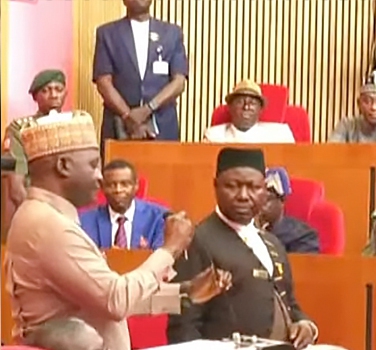
Tension rose in the Senate as lawmakers objected to attempts to conclude the screening of a former Chief of Defence Staff, General Christopher Musa (retd.), as the new Minister of Defence, and allow him to take a bow.
Senator Sani Musa of Niger East Senatorial District had urged the Senate to allow the former service chief to take a bow and leave after responding to a few questions.
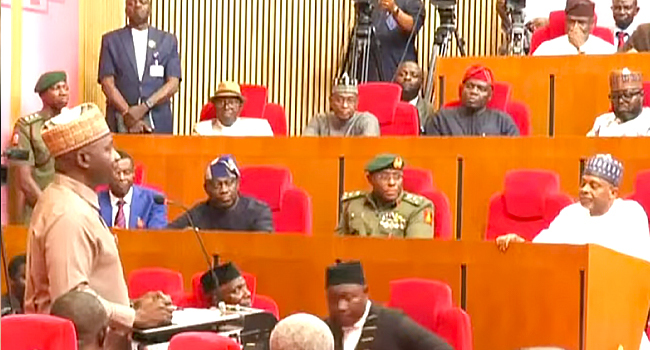
But those opposed to the idea insisted that the ministerial nominee must be subjected to more rigorous questioning.
The chamber became rowdy as senators stood in defiance, demanding further engagement with the nominee.
After several minutes of disruptions, the Senate President, Godswill Akpabio, rose, an action which, according to the rule book, signifies a call for order.
He urged the lawmakers to remain calm, underscoring that the purpose of the session was to ask questions that would reassure Nigerians during a period of heightened insecurity.
The Senate President, therefore, urged the nominee to investigate the circumstances surrounding the reported withdrawal of soldiers from the Kebbi school where the recent abduction of schoolgirls took place.
Responding to questions from lawmakers, General Musa expressed deep regret over the persistent insecurity in the country, describing the situation as very unfortunate.
He underscored the need to strengthen the safe-school initiative, noting that many schools remain exposed and vulnerable to attacks.
Community Resilience
The former CDS underpinned the importance of building the capacity of local communities and adopting a whole-of-society approach that integrates technology, community participation, and coordinated security operations.
According to him, such measures are critical to effectively addressing and ending the recurring incidents of kidnapping.
The nominee also highlighted the need to improve accountability within the armed forces while calling for full cooperation and coordination among Ministries, Departments, and Agencies (MDAs).
He said many agencies were not operating at full capacity and must harmonise their roles with one another and with neighbouring countries, given the transnational nature of terrorism.
He warned that Nigeria had more to lose if security institutions failed to work together, noting that terrorists often perceive the country as rich and therefore a prime target.
He reiterated the need for a zero-tolerance policy on terrorism and banditry, anchored on collaboration with local communities, since security is localised.
The nominee further pointed out that many existing laws remain obsolete and require urgent review.
He identified unregulated mining activities as a major source of funding for criminal groups and underscored the need for tighter monitoring supported by modern technology.
Leave a Reply