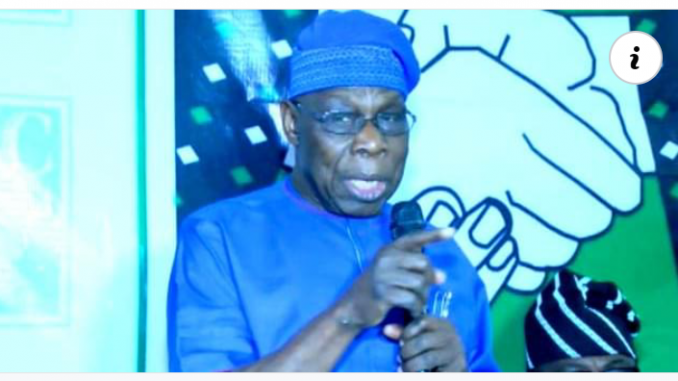
Former president, Olusegun Obasanjo, has taken a swipe at Nigeria’s prolonged security crisis, declaring that the country’s fight against Boko Haram and insurgency has dragged on so long that it has effectively become “an industry” sustained by beneficiaries within and outside government.
Speaking during the live-streamed Toyin Falola Interviews on Sunday, Obasanjo lamented that the 15-year-old Boko Haram war has now surpassed the 30-month Nigerian Civil War in duration, despite the nation’s heavy spend on defence and counter-terror operations.
The session featured Bishop Matthew Kukah of the Sokoto Diocese and former CBN Deputy Governor, Kingsley Moghalu, who also joined the conversation on Nigeria’s worsening security climate.
According to Obasanjo, Nigeria’s leadership has consistently failed to apply a precise combination of modern counterinsurgency tools — training, intelligence, technology, and specialised equipment — insisting that conventional military methods can’t defeat a scattered, embedded terror network.
“The military is trained for conventional war. If the people you are dealing with are fleeing targets or living among your people, you will need different types of training,” Obasanjo stated.
“Among the countries that have done that fairly successfully is Colombia. Should we invite them? There is no shame in that.”
The former Head of State, who crushed Niger Delta militancy during his tenure, dropped a bombshell suggesting there are cases of collusion and internal sabotage within Nigeria’s security architecture.
“The whole thing is an industry. It is an industry,” he declared. “Then you ask the military to be the ones buying equipment. It is not done. There is training, equipment, intelligence, and technology. These four must work together.”
Obasanjo warned that Nigeria cannot defeat terrorism if foreign partners do not trust Lagos and Abuja with critical intelligence due to persistent leakages, compromised officers, and infiltration of military structures.
Recounting his backchannel intervention in 2011, Obasanjo revealed that Boko Haram initially rejected negotiations with the Nigerian government but later agreed to a 21-day ceasefire — a diplomatic window squandered by Nigerian authorities.
“They agreed to 21 days of ceasefire to negotiate. Government failed to reach out,” he said.
Nigeria has spent trillions of naira on counterterrorism since 2009, yet banditry, mass abductions, and insurgent attacks continue across the North-West and North-East, while rural communities remain under ransom-driven terror.
Leave a Reply