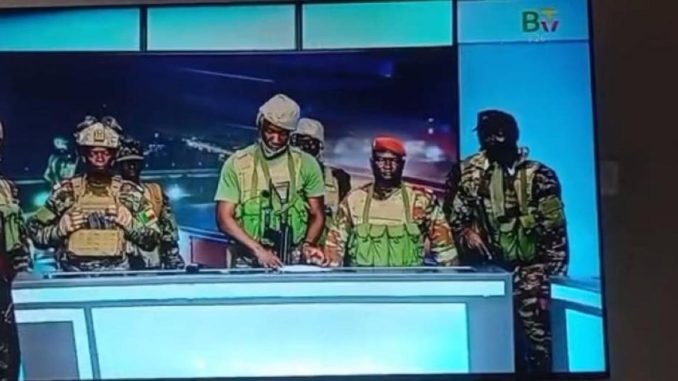
The leader of the failed coup d’état in the Benin Republic, Lt Col Pascal Tigri, is reportedly hiding in neighbouring Togo, according to a senior government official in Benin.
Speaking on condition of anonymity, the official said the Beninese government would formally request Tigri’s extradition, though Togo’s authorities have yet to comment publicly on the claim, according to the BBC.
The failed coup was the latest in a string of military coups and coup attempts across West Africa, fuelling growing concerns that democratic governance in the region is under increasing threat.
The plot was foiled after Nigeria deployed fighter jets to help dislodge mutinous soldiers from a military base and the offices of the state television broadcaster, following a request from President Patrice Talon’s government.
Early on Sunday, December 7, 2025, a group of soldiers appeared on state television to announce that they had seized power, while gunfire was reported near the presidential residence.
However, after the failed coup, the leader of the coup plotters, Tigri, escaped from the country and went into hiding.
French special forces also assisted loyalist troops in thwarting the coup attempt, according to the head of Benin’s Republican Guard, who spoke to journalists.
Togo is a member of the Economic Community of West African States (ECOWAS), which swiftly condemned the attempted coup.
SaharaReporters earlier reported that the regional bloc had since deployed troops from Nigeria, Ghana, Sierra Leone and Côte d’Ivoire to secure key installations across Benin.
Benin, a former French colony, has long been regarded as one of Africa’s stable democracies.
However, despite being one of the continent’s largest producers of cotton, it remains among the world’s poorest countries.
Nigeria condemned the incident, describing the coup attempt as a “direct assault on democracy”.
Benin Government spokesman Wilfried Léandre Houngbédji reportedly said that only a small number of soldiers from the National Guard were involved.
“The National Guard is a recent creation within our army, initiated by President Talon as part of our fight against terrorism,” Houngbédji said, according to the BBC.
“It is a land forces unit equipped with significant resources, following major investments in recent years, and its personnel are well trained,” he said.
In a statement broadcast during the brief takeover attempt, the rebel soldiers accused President Talon of mismanaging the country, citing the “continuing deterioration of the security situation in northern Benin.”
Benin’s military has suffered repeated losses near its northern borders with Niger and Burkina Faso, where jihadist groups linked to Islamic State and al-Qaeda have expanded their operations southwards in recent years.
The soldiers also criticised what they described as “the ignorance and neglect of the situation of our brothers in arms who have fallen at the front and, above all, that of their families, abandoned to their sad fate by Mr Patrice Talon’s policies.”
They further condemned cuts to healthcare services, including the cancellation of state-funded kidney dialysis, tax increases, and restrictions on political activities.
President Talon, a businessman often described as the country’s “king of cotton”, came to power in 2016 and is expected to step down next year after completing his second term, with elections scheduled for April.
He has reportedly endorsed Finance Minister Romuald Wadagni as his preferred successor.
The attempted coup came just over a week after Guinea-Bissau’s President Umaro Sissoco Embaló was reportedly overthrown, though some regional figures, including Nigeria’s former President, Goodluck Jonathan, have questioned the circumstances of Guinea-Bissau’s event.
In recent years, coups have also occurred in Burkina Faso, Guinea, Mali and Niger, deepening fears over West Africa’s stability.
Russia has strengthened ties with several of these Sahel states, while Burkina Faso, Mali and Niger have withdrawn from ECOWAS to form the Alliance of Sahel States.
Leave a Reply